What a Screen Version Leaves Outside the Frame
When a book’s narrator moves inside a character’s thoughts, a screen adaptation must choose what to show, what to hear and what to leave unresolved. The right choice depends on the kind of inner account the story needs.
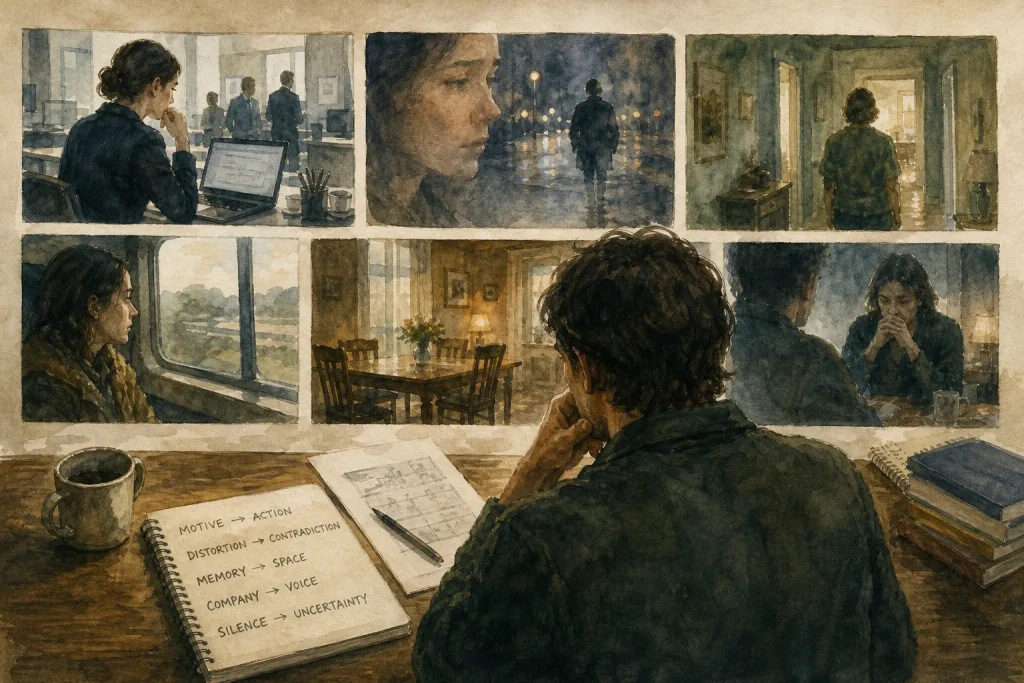
A screen adaptation cannot show a thought in the same way a novel can state it, so it has to decide where that thought will live: in a face, a voice, a room, an object or a gap. The best choice depends on what the narration is doing. A sentence may explain a motive, distort an event, hide a fact or simply keep a character company; those functions call for different screen language.
When thought explains
If the narrator mainly clarifies why a character acts, start with the action and its immediate surroundings. A pause before answering, a hand left on a door handle, or a letter folded and put away can carry motive without translating every sentence into voice-over. This fits stories where the reader needs to understand a decision, but does not need a running account of the character’s mind.
Choose a visible detail only when it is specific to the character’s situation. A spotless desk might suggest control in one story, but it is merely a spotless desk in another. The image needs a relation to the choice at hand: what the character handles, avoids or changes gives the audience something to read.
Say a novel’s narrator explains that a junior solicitor delays sending a message because she fears disappointing her father. In an invented adaptation, she could draft the message at her office computer, remove the greeting, then close the screen when colleagues pass. The observable action makes the hesitation legible; a later conversation can reveal whether fear or some other motive was driving it. This approach fits when the uncertainty is part of the character, not a puzzle the plot must solve immediately.
When thought distorts
If the narrator’s account is unreliable, do not turn every claim into an objective-looking image. A camera can make an imagined memory feel like a confirmed event simply by showing it with the same visual authority as the present. Instead, give the audience a reason to question the image: a repeated detail changes, the sound belongs to another moment, or a cut returns to a room that does not match the narrator’s description.
This is a good fit when the gap between what a character says and what the audience can verify drives the story. Voice-over may still help, but it should have a clear relationship with the image. A calm account over a scene that quietly contradicts it can sharpen doubt; an account that merely repeats what is visible tends to flatten it.
Keep the uncertainty deliberate. If every detail is made strange, viewers have no stable ground from which to notice a contradiction. A familiar object, a consistent location or a steady performance can act like the straight edge of a ruler: it makes the deviation easier to see. The adaptation need not explain the discrepancy at once, but it should let the audience recognise that one exists.
When memory has texture
Some narrators do more than report events: they remember them through a particular sensory or emotional filter. In that case, a space can carry the inner account. A narrow corridor, a kitchen table that seems too large, or a street seen through rain can make recollection tangible without claiming that memory is a perfect record.
Choose this method when place shapes what the character can admit. Production design, framing and movement can all contribute. A character who feels trapped might be held at the edge of a crowded room; one who romanticises the past might return to a familiar house whose worn details resist that polished memory. The point is not to decorate a feeling, but to let the space put pressure on it.
Use a recurring place carefully. If it changes each time the character remembers it, the difference should relate to the story’s emotional movement, not just provide visual variety. A shift from a warmly lit dining room to the same room with daylight exposing its clutter can suggest a changed recollection. It cannot, by itself, establish what happened there.
When thought keeps company
A narrator may speak inwardly not to explain the plot but to create a distinctive presence: observant, funny, defensive or lonely. In that situation, removing the voice altogether can leave the adaptation technically clear but emotionally thin. Voice-over is a sensible fit when the voice’s rhythm and judgements are themselves part of the pleasure.
Keep the spoken words selective. Let them add a judgement the image cannot supply, complicate what is shown or establish a way of noticing. A voice that says a character’s name while the character stands in view adds little; a voice that notices the chipped mug everyone else ignores may reveal a habit of attention. The image and the narration should be in conversation, not taking turns to repeat the same information.
Performance can also carry inwardness without dialogue. An actor’s timing, gaze and small adjustments to posture give thought a visible surface, though they do not make it fully transparent. This fits when the character is guarded or unsure even to themselves. Resist directing a single gesture as a universal sign for a particular emotion: a glance away can indicate shame, distraction or simple fatigue, depending on the scene.
When silence fits
Sometimes the inner account is valuable precisely because the screen cannot settle it. If a novel withholds a character’s motive, translating that uncertainty into a definitive reaction may narrow the story. A held shot, an unanswered question or a cut away before the response can preserve room for interpretation.
This choice fits when the audience should weigh competing explanations rather than receive a coded answer. It works best when the surrounding scene supplies enough concrete information to make those explanations plausible. Silence without context can feel like missing information; silence after a meaningful choice can feel charged.
For a scene built around an apology, for instance, an invented adaptation might keep the camera on the listener after the apology ends, rather than cutting to the speaker’s hopeful expression. The listener’s response remains visible but unreadable, so the audience can attend to the words, the history between them and the lack of an immediate resolution. This preserves uncertainty without pretending that a close-up can disclose a complete inner life.
Choosing the screen language
Start by asking what a passage of narration contributes, then choose the method that preserves that contribution. Use action for motive that can be inferred, contradiction for an account the audience should doubt, spaces for memory shaped by place, voice-over for a distinctive observing mind, and silence when uncertainty is the point. More than one method can work in a scene, but each should add something different.
Also consider how much the audience needs to know at that moment. A visible clue can make a private thought public; a spoken line can tell viewers what the character believes; a withheld response can protect the gap between belief and fact. The frame is not simply a container for the book’s contents. It is a boundary that lets an adaptation choose which parts of an inner account become evidence, which remain interpretation and which are left for the viewer to carry away.