The Locked-Room Mystery Without the Locked Room
A mystery can feel tightly bounded in a city, a landscape or a crowded institution. The trick is to limit what the audience needs to solve, then make each clue change the shape of that question.
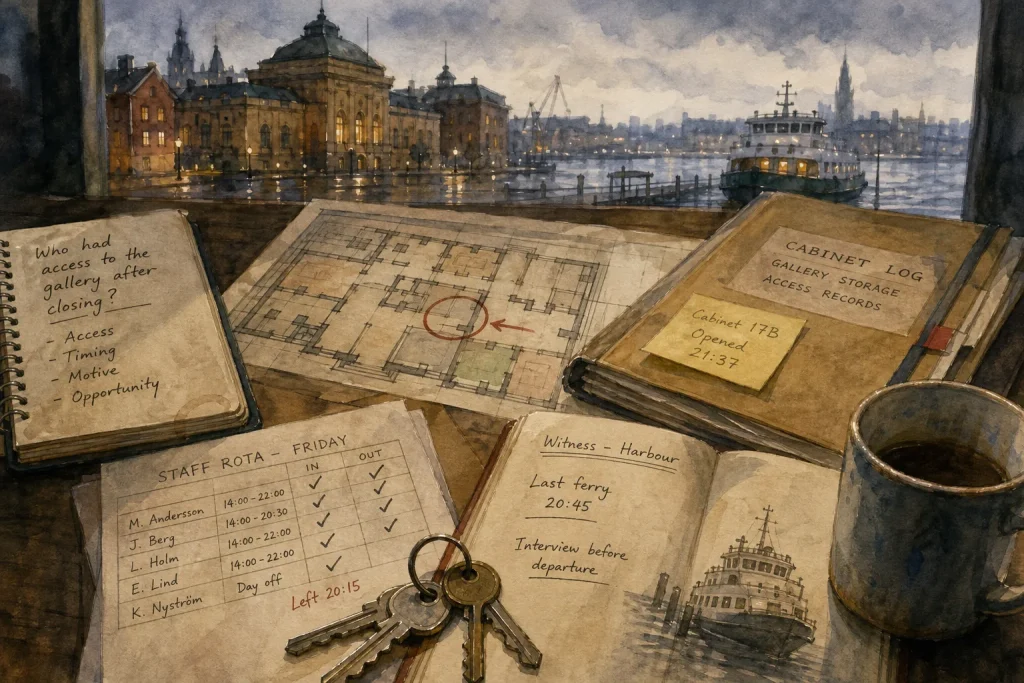
A mystery set across a city can feel more contained than one set inside a locked room if the audience understands what the investigation can reach. The boundary is a clear question and a credible route through the people, places and records that bear on it. Without that shape, each new lead can feel like a door the writer has opened simply because the plot needs another corridor.
Screen stories can make those limits visible through repeated locations, restricted points of view and choices that carry consequences. A ferry timetable may constrain a witness’s account; a workplace access log may narrow who could enter a room. These devices matter less as clues than as parts of an investigation with a recognisable scope.
One central question
A mystery loses its shape when its central question changes without warning. The audience may begin by asking who injured a museum guide, then learn that the real puzzle is an unrelated conspiracy. A reveal can broaden the stakes, but it should also clarify why the original question mattered.
Keep a distinction between the main question and the smaller questions that serve it. A false alibi might change who could have entered a gallery; a lie about a family dispute may matter only if it affects access, timing or motive. If a revelation does not narrow the possible answers, alter the stakes of the central question or explain why an earlier answer fails, it may belong to a separate plot.
Say you are outlining an invented mystery about a guide injured after a museum closes. The starting question is who had access to the gallery. A staff rota shows that three people were present; a later conversation establishes that one left before the incident, reducing the live possibilities to two. The answer has not arrived, but the investigation has changed in a visible way: the rota now matters because it helps define who could act.
Limits with consequences
A wide setting can make an investigation feel arbitrary if characters can consult anyone or go anywhere without cost. Give the story limits the audience can understand: a storm closes a mountain road, a ferry leaves before a witness can return, or a records office is accessible only through a particular supervisor. The limit should shape a decision, not merely decorate the setting.
Repeated locations can also make a larger world legible. A station platform, a kitchen and a records office form a usable map when each has a distinct relation to the investigation. Like keys on a hook, places should be easy to tell apart; the audience should understand what a return to each one might make possible.
For example, imagine an invented story in which a witness can be interviewed only at the harbour before the last ferry departs. The detective first plans to visit the records office, then learns the witness is leaving that evening. The detective chooses the harbour, and the expected observable result is a conversation that can test the witness’s account before that route closes. The trade-off is clear: the records search must wait, rather than appearing to vanish from the story.
Distinct suspect roles
A cast can blur when every suspect has a motive, an opportunity and a secret, but no clear relation to the event. The audience may remember that everyone seems suspicious while losing track of why any one person matters.
Give suspects different functions in the investigation. One may control access, another may benefit from a mistaken timeline, a third may know who handled a document, and another may be protecting someone. These roles are not proof of guilt; they help the audience understand what each person’s account could change.
Behaviour can distinguish characters without turning every gesture into a hidden clue. One person may answer before a question is finished; another may insist on exact wording. Such details become meaningful only if later events give them a specific bearing on the investigation. Otherwise, they remain characterisation rather than evidence.
Scene choices that matter
A bounded mystery still needs movement. Interviews, searches and confrontations feel interchangeable if they add information but do not change what anyone does. After a major scene, ask whether the suspect list, the timeline, a relationship of trust or the cost of continuing has changed.
Consider an invented outline with three initial leads: check a staff rota, speak to a witness at the harbour, or search a storage cupboard. The rota confirms that a staff member left before the incident, so the detective crosses that person off the immediate access list. The harbour witness is due to leave, so the detective goes there next. The cupboard search is postponed because it cannot resolve the time-sensitive question. Each action follows from an observable change, and the choice has a cost: the cupboard remains unchecked for now.
If a scene leaves every decision untouched, it may be repeating a function already served. If new information points towards another action, show who chooses it and why. A clue becomes part of the story’s structure when it changes the next move, not merely when the camera lingers on it.
Evidence and emphasis
Viewers need to understand why a piece of evidence matters without being told that every detail is significant. If each prop receives a dramatic close-up and each pause carries ominous music, the story gives ordinary information the same emphasis as decisive evidence.
Instead, let evidence gain importance through its relation to the question. A key may be ordinary in a building where several people handle keys. It becomes relevant if a record shows that it opens a cabinet connected to the timeline. The point is not to hide the answer in an object but to make the object’s bearing on access clear when the investigation reaches it.
In the invented museum story, suppose the staff rota leaves two people with access, while a cabinet record shows that one of them opened it after the gallery closed. The detective checks the cabinet’s contents against the guide’s account and finds that a relevant document had already been moved. That action shifts attention towards who handled the document, rather than simply treating the key as a sign of guilt. The expected result is a new question about timing and access, not an instant solution.
A legible solution
A surprising answer can still disappoint if its decisive fact appears only at the end. Let the explanation rearrange information the audience has already encountered, rather than depend on a new piece of evidence delivered in the final scene.
Scene order can help viewers reconsider what they saw. A cut from a suspect’s account to an empty gallery may raise doubt; returning there after a witness describes the closing routine can give that image a different context. Allow a pause for the new connection to register before the dialogue moves on.
The audience need not solve the mystery first. It should be able to see why the answer fits once the relevant events and choices are set beside one another. The most convincing boundary is not a wall around the setting, but a clear line from question to decision to consequence.
One useful final check is to follow the investigation through the places it has already visited. If a return to the harbour, the kitchen or the records office changes what a character believes or does, the setting is helping hold the mystery together. If the place is only a backdrop, the story may need a clearer reason to go back.